
If you’re teaching a child to read, you already know this moment:
You show a picture of a cat and ask, “What sound do you hear first?”
They pause. They guess. Sometimes they get it right. Sometimes they don’t.
That first sound — that tiny little sound at the beginning of a word — is where reading truly begins.
That’s why I created these beginning sounds worksheets for kindergarten. They are simple, clear, and designed for real children who are just starting to connect letters and sounds.
Download Free Beginning Sound Worksheets PDF
These worksheets are completely free to download and print.
- Covers all 26 letters
- Designed for ages 4–6
- Easy-to-understand picture clues
- No sign-up required
Why Beginning Sounds Matter So Much
Before children can read words, they need to hear sounds.
Not the whole word. Just the first sound.
When a child can hear that a dog starts with /d/ and a sun starts with /s/, they are building the foundation for reading and spelling.
This skill:
- Builds confidence
- Makes letter learning meaningful
- Helps with early writing
- Prepares children for reading simple words
Kindergarten is the perfect time to practice this in a playful and gentle way.
That’s exactly what these worksheets are designed to do.
What’s Inside These Beginning Sounds Worksheets for Kindergarten
I created these worksheets to move from easier tasks to slightly more challenging ones. Children don’t all learn at the same pace, so variety matters.
Here’s what you’ll find inside:
1. Colorful Letter Connection
Children look at a picture and color the letter that matches its beginning sound.
This activity is great for beginners because:
- The choices are clear.
- The visuals are supportive.
- Coloring keeps it engaging.
It feels like a game, but it builds strong letter-sound recognition.

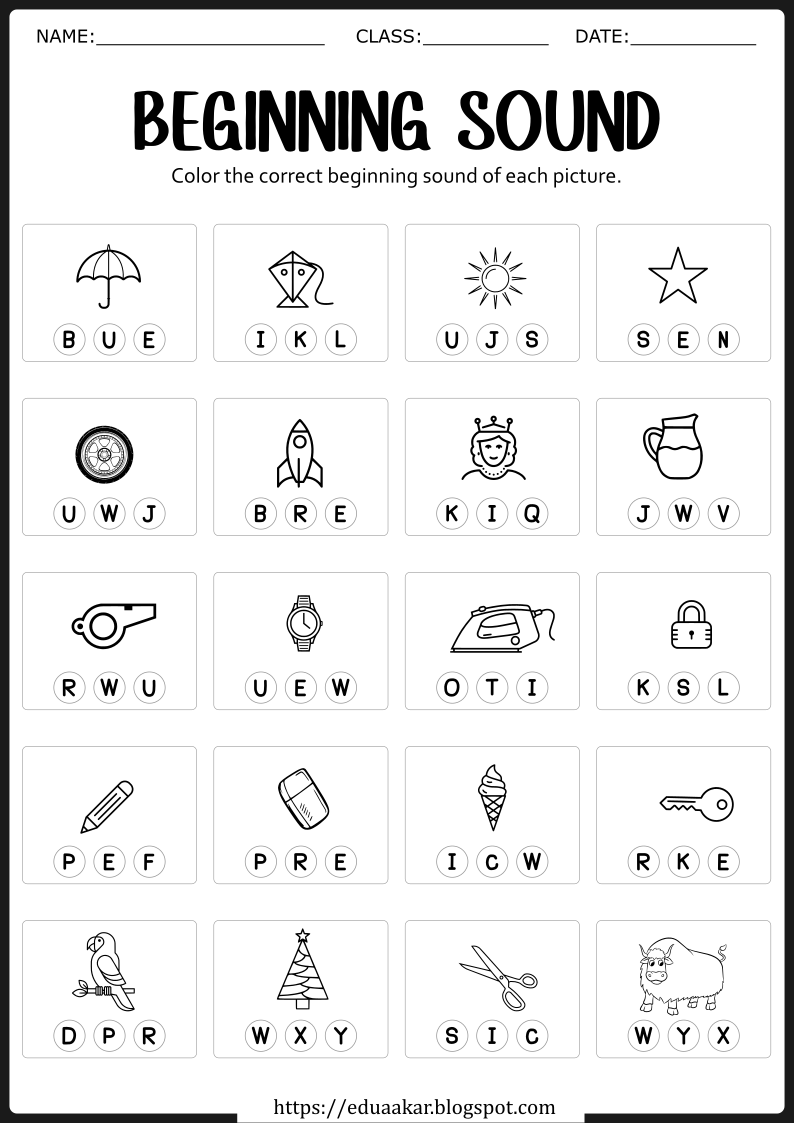


2. Picture-to-Letter Matching (Initial Sound Worksheets)
In these pages, children draw lines from pictures to the correct beginning letter.This helps them:
- Compare sounds
- Slow down and think
- Avoid random guessing


3. Write the Beginning Sound of Each Picture
This is where children move from recognizing to producing.They look at the picture, say the word aloud, and write the first letter.
This small shift makes a big difference.
When a child writes the letter themselves, they are actively connecting:
- What they hear
- What they see
- What they write


4. Letter Entry Challenge
In this activity, children fill in the missing first letter next to each picture.Picture names are provided as helpful clues, so children feel supported rather than stuck.
This builds confidence while still encouraging independence.


5. Sound Identification Challenge
This activity removes extra hints.Children must rely only on what they hear.
It gently stretches their listening skills and prepares them for early reading.


How I Designed These Worksheets
I created these worksheets with real children in mind.
Over time, I’ve noticed a few things:
- Too many distractions on a page confuse young learners.
- Tiny fonts make writing frustrating.
- Overcrowded layouts overwhelm children.
So I kept everything:
- Clean
- Clear
- Age-appropriate
- Easy to print
Each picture was chosen carefully so the beginning sound is obvious and not confusing.
For example, simple words like:
- Cat
- Sun
- Ball
- Dog
Clear sounds. Clear pictures. Clear learning.
How to Help a Child Hear the First Sound
If a child struggles, don’t worry. That’s normal.
Here’s what works well:
- Say the word slowly.
- Stretch the first sound: “ssssun.”
- Ask, “What sound did you hear at the start?”
- Let them repeat it.
- Then match it to the letter.
Keep it light and encouraging.
If they guess wrong, gently model the sound and try again.
Short practice sessions (5–10 minutes) work best at this age.
Who Can Use These Worksheets?
These initial sound worksheets are perfect for:
- Kindergarten teachers
- Preschool teachers introducing phonics
- Homeschool families
- Parents preparing their child for school
- ESL learners building early sound awareness
They’re simple enough for beginners and structured enough to support real progress.
Download Your Free Beginning Sound Worksheets PDF
If you’re ready to get started:
Download the printable PDF and print the pages you need.
You can use them:
- At home
- In the classroom
- In small groups
- As independent practice
No login. No complicated steps. Just print and teach.

Frequently Asked Questions
What are beginning sounds worksheets?
They are worksheets that help children identify the first sound they hear in a word.
At what age should children learn beginning sounds?
Most children start around ages 4–6, depending on readiness.
Are these suitable for preschool (Pre K)?
Yes. If a child recognizes some letters, they can begin practising beginning sounds.
What if my child confuses sounds?
That’s completely normal. Practice slowly, say words clearly, and keep sessions short and positive.
A Final Thought
Teaching a child to read doesn’t happen overnight.
It happens in small moments.
Moments like hearing the /b/ in ball. Or writing the letter m after saying moon.
Those tiny steps add up.
I hope these beginning sounds worksheets for kindergarten make those early steps easier and more enjoyable for you and your learners.
Download them, print them, and start with just one page today.
You might be surprised how quickly those first sounds start to click.
I mostly lived these worksheets. There were a couple pictures that were hard to know what they were. Once there wasn’t a p to circle for the pizza word. And then in the write the beginning sound words like knife, eye sharpener are not good for beginner learners. Again I think my kiddo learned a lot from these exercises but I think there could be improvements. Thank you!
ReplyDeleteThank you so much for your thoughtful feedback! I’m glad to hear your kiddo learned a lot from the worksheets, and I truly appreciate you taking the time to share your experience.
DeleteRegarding the missing 'P' in the activity, I’ll make sure to correct that right away (It is fixed in the PDF)—thank you for catching it! As for the beginning sound words, I understand how simpler, more familiar examples might work better for beginners. I chose words like "knife," "eye," and "sharpener" to expand the range of vocabulary, but I see how this could be adjusted for clarity and ease.
I’ll keep your suggestions in mind for future updates to make the worksheets even more user-friendly. Your input helps me improve, and I’m so grateful for your support! 😊
Hi can I ask which letter should I match with the picture of third position at right on sixth worksheet ,the one look like Christmas tree or pine tree ,but there is no c or p option ,thank you so much !
ReplyDeleteHi Bill,
DeleteWell, that tree is a Christmas tree. The right answer is X-Mas. Therefore, you need to connect it with X. I hope this helps.